If you’re dealing with cat hair on every surface of your home, you’ve probably come across the FURminator for cats while searching for a fix. It’s one of the most talked-about deshedding tools on the market, but it’s also one of the most misunderstood — some owners swear by it, others say it did nothing, and a few worry it’s too harsh for their cat’s skin.
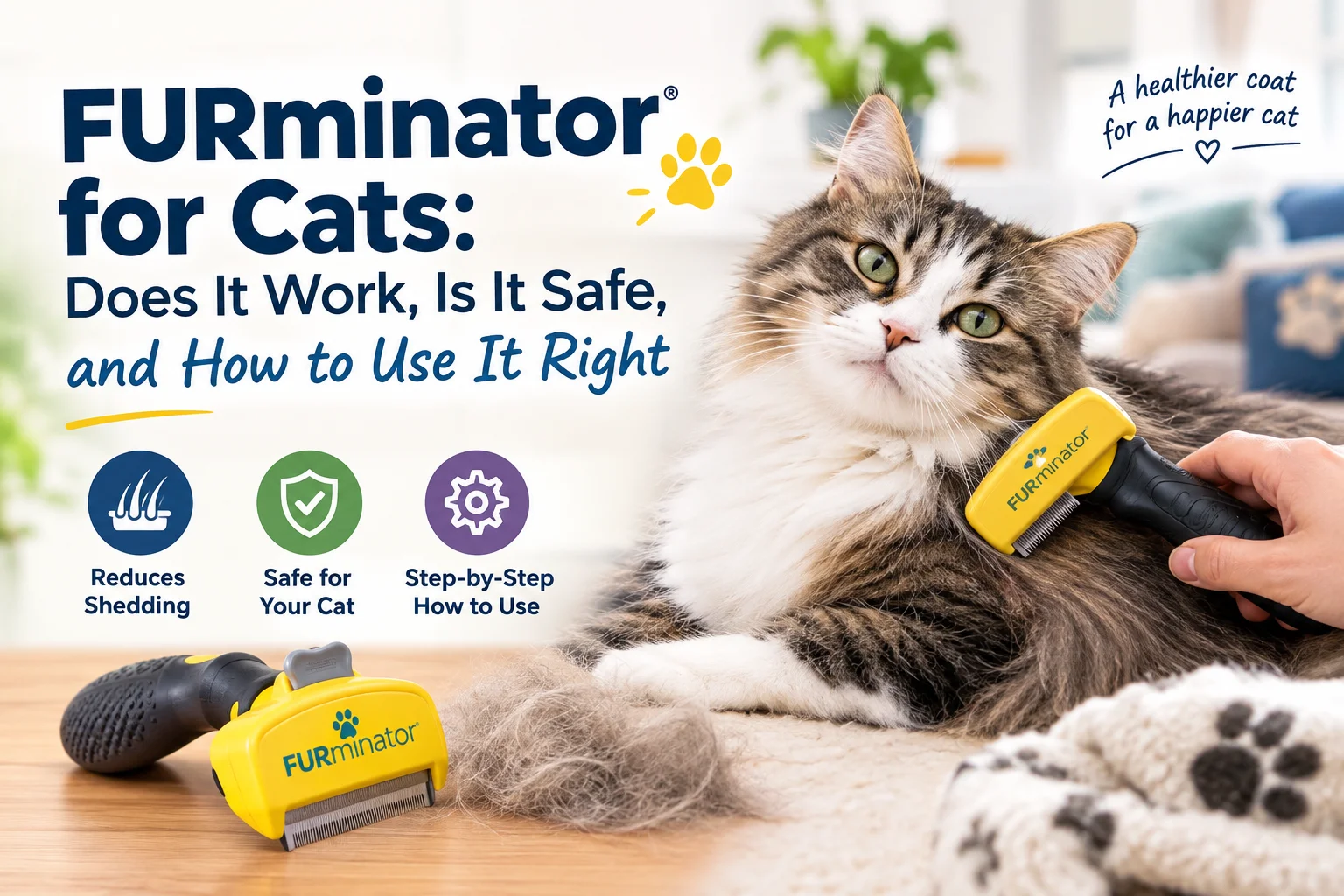
The short answer: a FURminator can meaningfully reduce loose undercoat shedding when used correctly on a cat that tolerates grooming well, but it isn’t a cure-all, it isn’t necessary for every cat, and it can cause skin irritation if used too aggressively or too often. The rest of this guide breaks down exactly how it works, how to use it safely, and how to decide if it’s the right tool for your specific cat.
What Is a FURminator for Cats?
The FURminator cat brush is a deshedding tool built around a row of fine, closely spaced metal teeth designed to reach through a cat’s topcoat and pull out loose hair from the undercoat — the soft, insulating layer beneath the visible fur. It’s different from a standard bristle or pin brush, which mostly smooths the surface coat and picks up hair that’s already loose.
FURminator markets separate tools for short-haired and long-haired cats, plus different sizes for smaller versus larger cats. The exact lineup, blade lengths, and edition names change over time, so it’s worth checking the manufacturer’s current product page rather than relying on older reviews for exact specs. [Internal Link: Best Cat Brushes]
How Does the FURminator Work?
The tool’s stainless steel teeth are spaced to slide under the topcoat and catch loose undercoat hair without (in principle) cutting or pulling at healthy, attached fur. As you draw the tool through the coat in the direction of hair growth, loose hair collects on the teeth, and most versions include a release button or eject mechanism to remove the collected fur.
This is a mechanical approach to deshedding — it doesn’t use any product, spray, or chemical process. The result depends heavily on:
- Coat type and density
- How much loose undercoat the cat is currently carrying
- Technique and pressure applied
- How tolerant the cat is of grooming sessions
Does a FURminator Really Work for Cats?
For cats that shed a noticeable undercoat — many domestic shorthairs and longhairs, especially during seasonal shedding — a FURminator can remove a substantial amount of loose hair in a single session compared to a standard brush. Many owners report seeing less hair on furniture and floors after a few sessions.
That said, it’s important to be realistic about what “works” means here:
- It removes loose hair that’s already ready to shed; it does not stop the biological shedding process itself.
- Results vary by coat type. Cats with very fine, sparse coats or minimal undercoat may not see a dramatic difference.
- It’s not a substitute for addressing shedding caused by diet, health issues, or environmental factors — if a cat is shedding unusually heavily, that’s worth mentioning to a veterinarian rather than assuming a brush will fix it.
No deshedding tool, including the FURminator, should be marketed or understood as guaranteeing a shed-free home.
Is a FURminator Safe for Cats?
Used correctly, on a cat with healthy skin and coat, the FURminator is generally considered a low-risk grooming tool. However, “generally low-risk” is not the same as “risk-free,” and a few real concerns are worth understanding:
- Overuse can irritate skin. Because the teeth reach into the undercoat, pressing too hard or brushing the same area repeatedly can cause redness, scratches, or discomfort, particularly on cats with thin or sensitive skin.
- It’s not designed for mats. Attempting to pull a FURminator through a dense mat can hurt the cat. Mats should typically be addressed separately (often by a groomer or vet) rather than brushed through with a deshedding tool.
- Not every cat tolerates it. Some cats are sensitive to the sensation, especially around the belly, legs, and tail.
- Coat and skin conditions matter. Cats with pre-existing skin conditions, very thin coats, or fragile skin (including some senior cats) may need a gentler approach — this is a good conversation to have with a vet before starting.
Always follow the manufacturer’s current instructions for your specific model, and stop immediately if your cat shows signs of pain, resists strongly, or develops any skin irritation.
How Often Should You Use a FURminator on a Cat?
There’s no single “correct” frequency that applies to every cat, and manufacturer guidance can vary by product version, so check the current instructions included with your specific tool. As a general grooming principle used by many groomers:
- Short-haired cats: roughly once a week is a common starting point for maintenance shedding.
- Long-haired cats: more frequent light sessions (for example, a few times a week) are often more comfortable than one long, intense session, especially during seasonal shedding.
- Heavy shedding seasons (spring/fall): some owners increase frequency temporarily, then taper off.
The safest approach is to start with shorter, less frequent sessions, watch how your cat’s skin and coat respond, and adjust from there — rather than assuming more is better.
How to Use a FURminator on a Cat
Technique matters more than the tool itself. Here’s a practical, low-stress approach:
- Choose a calm moment. Pick a time your cat is relaxed — after a meal or during a nap-adjacent lull works well for many cats.
- Start with a regular brush first. A quick pass with a soft or pin brush removes surface debris and helps you spot mats before using the FURminator.
- Check for mats or tangles. If you find any, address them separately (gently working them out by hand, or with a groomer’s help) rather than brushing over them with the deshedding tool.
- Use light, short strokes in the direction of hair growth. Avoid pressing hard — let the teeth do the work rather than forcing them through the coat.
- Work in small sections. Move across the body in manageable areas rather than long, continuous strokes over sensitive zones like the belly, hips, or tail.
- Watch your cat’s body language. Flattened ears, tail flicking, or attempts to move away are signs to slow down or stop.
- Keep sessions short, especially at first. A few minutes is plenty for a first session; you can build up gradually.
- Remove collected fur regularly during the session using the tool’s eject feature, so the teeth stay effective.
- Finish with praise or a treat so your cat associates grooming with something positive.
[Internal Link: Cat Grooming Guide]
Choosing the Right FURminator: Short-Haired vs. Long-Haired Cats
FURminator’s product lines are generally split by coat length and cat size, because tooth spacing and length are calibrated differently for each:
- Short-haired cats typically pair with tools designed with shorter, closer-set teeth suited to a denser, tighter undercoat.
- Long-haired cats typically pair with tools designed with longer teeth spaced to reach through a thicker topcoat without snagging as easily.
- Size (small vs. medium/large) affects the width of the tool’s head and handle, which is mostly about comfort and maneuverability for you and appropriate scale for your cat.
Because exact model names, tooth lengths, and size categories are updated by the manufacturer over time, check FURminator’s current product listings or packaging to match the tool to your cat’s specific coat length and size rather than relying on older articles or reviews.
Comparison Table: Matching the Tool to Your Cat
| Cat Type | Coat Description | Recommended Tool Type | Important Considerations |
|---|---|---|---|
| Short-haired cats | Dense, tight undercoat, short topcoat | Short-hair deshedding tool | Generally tolerates more frequent light sessions; watch for over-brushing on thin-skinned areas |
| Long-haired cats | Longer topcoat, thick undercoat, prone to matting | Long-hair deshedding tool | Check for mats before using the tool; more frequent, shorter sessions often work better than long ones |
| Small cats / kittens | Varies; smaller body frame | Small-size tool, gentle technique | Kittens may not need deshedding tools at all; introduce grooming gradually and check age guidance |
| Medium/large cats | Varies; larger body frame | Medium/large-size tool | Larger surface area to cover — work in sections rather than one long pass |
This table reflects general grooming principles rather than a specific product’s technical specifications. Always confirm sizing and coat-type recommendations against the current FURminator product information. [Internal Link: Best Cat Grooming Tools]
Can Grooming Help With Hairballs?
Regular grooming — including with tools like a FURminator — removes loose hair before a cat can ingest it during self-grooming, which is one plausible way that consistent brushing could reduce hairball frequency for some cats. However, this is a general grooming principle, not a guaranteed outcome, and it should not be presented as a medical claim.
Hairballs can have multiple contributing factors, including diet, digestive health, and grooming habits. If a cat is having frequent or severe hairball issues, that’s a conversation for a veterinarian rather than something to address through brushing alone.
FURminator vs. Regular Cat Brush: What’s the Difference?
| Feature | FURminator-Style Deshedding Tool | Regular Cat Brush (bristle/pin/slicker) |
|---|---|---|
| Primary target | Loose undercoat hair | Surface coat, tangles, general smoothing |
| Typical effect on shedding | Can noticeably reduce loose hair during active shedding | Helps maintain coat but generally removes less undercoat |
| Skin sensitivity risk | Higher if overused or pressed too hard | Generally lower risk with normal use |
| Good for daily use? | Often used less frequently (per manufacturer guidance) | Often suitable for more frequent daily use |
| Good for mats | Not designed for mat removal | Some brushes handle light tangles better |
Neither tool replaces the other entirely — many owners use a standard brush for regular maintenance and a deshedding tool during heavier shedding periods. [Internal Link: How to Reduce Cat Shedding]
Common Mistakes Cat Owners Should Avoid
- Brushing over mats instead of removing them first. This can pull on skin and cause pain.
- Pressing too hard. The tool doesn’t need force to work — let the teeth glide through loose hair.
- Using it too frequently without watching for irritation. More sessions aren’t automatically better.
- Ignoring your cat’s stress signals. Forcing a session on a cat that’s clearly uncomfortable can make future grooming harder.
- Using the wrong size or coat-type version. A tool designed for a different coat length may not perform as expected and could be less comfortable for your cat.
- Skipping the current product instructions. Manufacturer guidance can change between product versions.
When Should You Stop Grooming and Contact a Veterinarian?
Stop the session and consult a veterinarian if you notice:
- Redness, scratches, or visible skin irritation after brushing
- Bald patches, thinning fur, or scabs unrelated to grooming
- Your cat showing pain, aggression, or strong avoidance during grooming
- Sudden or unusual increases in shedding
- Mats that are tight against the skin and difficult to remove safely
- Any signs of a skin infection or unusual odor
A vet can help determine whether excessive shedding or skin sensitivity has an underlying cause unrelated to grooming technique.
Frequently Asked Questions
Is a FURminator good for cats?
It can be a helpful tool for reducing loose undercoat hair in cats that tolerate grooming well, but it isn’t necessary or ideal for every cat, and results depend on coat type and technique.
How often should you FURminate a cat?
This depends on coat type and the specific product’s guidance — many owners start with once a week for short-haired cats and more frequent, shorter sessions for long-haired cats, then adjust based on their cat’s response.
Can a FURminator hurt my cat?
It can cause discomfort or skin irritation if used with too much pressure, too frequently, or over mats. Using gentle technique and following current product instructions reduces this risk.
Does FURminator work on long-haired cats?
Long-haired coats generally pair with a long-hair-specific version of the tool. It can help manage undercoat shedding, but mats should be addressed separately before brushing.
What’s the difference between FURminator sizes?
Sizes are generally matched to the cat’s body size for comfortable handling, while coat-length versions (short vs. long hair) are matched to coat type and tooth length. Check current manufacturer specifications for exact sizing.
Can I use a FURminator every day?
Daily use isn’t typically recommended for most cats; check the specific product’s guidance, and watch your cat’s skin for any signs of irritation regardless of frequency.
Does a FURminator prevent hairballs?
It may help reduce hairball frequency for some cats by removing loose hair before it’s ingested during self-grooming, but it doesn’t eliminate hairballs and isn’t a guaranteed solution.
What’s the difference between a FURminator and a regular cat brush?
A FURminator-style tool targets loose undercoat hair specifically, while a regular brush mostly manages the surface coat and tangles. Many owners use both for different purposes.
Is FURminator safe for kittens?
Kittens have more delicate skin, and deshedding tools may not be appropriate at a young age. Check age-specific product guidance and consider starting with gentler grooming tools instead.
Do I need a FURminator if my cat doesn’t shed much?
Not necessarily. Cats with minimal shedding or thin coats may do fine with a standard brush, and a deshedding tool may offer little added benefit for them.
Conclusion
A FURminator for cats can be a genuinely useful addition to a grooming routine for cats that shed a noticeable undercoat, but it works best when matched to the right coat type, used with gentle technique, and applied at a frequency your cat’s skin tolerates well. It isn’t a guaranteed fix for shedding or hairballs, and it isn’t the right choice for every cat — especially those with mats, sensitive skin, or minimal undercoat.
Before buying, match the tool to your cat’s coat length and size using current manufacturer specifications, and don’t hesitate to check in with a veterinarian if shedding seems unusual or your cat reacts poorly to grooming.
Suggested authoritative sources to reference (do not fabricate specific citations): the manufacturer’s official FURminator product and usage pages, and veterinary or animal-health organizations (such as a veterinary association’s grooming or feline coat-care resources) for general grooming and skin-health guidance.